Google's SEO check gives your site a 90. Can AI read it too? For 4 in 10 sites, no.
Visitors who arrive at an online store through an AI assistant buy 60% more often and bring 53% more revenue per visit, Adobe measures. But can AI read your site? We measured 155 small business websites: of the 129 that score 90 or more on Google's own SEO check, 51 score below 40 on AI readability.

Google says your site is fine
You have done the work. The site is fast, the titles are right and when you run it through Lighthouse, the SEO check Google built into Chrome, there is a green number above 90.
So AI is sorted too?
We measured that question. The answer: for 4 in 10 sites, no. First, why that costs money.
Visitors from AI buy more often
Adobe measures what visitors do in US online retail, across more than 1 trillion visits. Their August 2026 report shows that someone who arrives through an AI assistant is a better customer than a visitor from other channels:
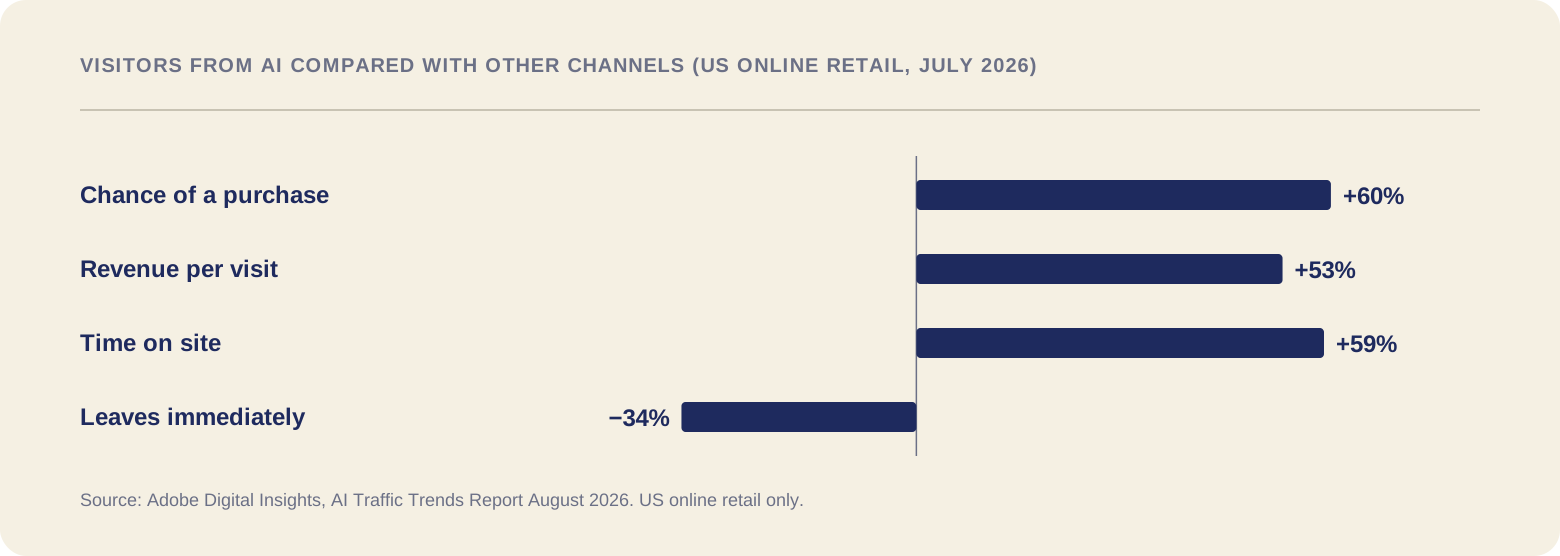
That visitor buys 60% more often, brings 53% more revenue per visit, stays 59% longer on the site and leaves immediately 34% less often. A year earlier it was the other way round: visitors from other channels bought more often.
A hint at why is in the survey Adobe ran alongside, of more than 5,000 Americans. 66% say they go to a business’s website to verify a recommendation from AI. 89% click the sources an assistant names. Someone who comes through AI has half made the choice already and comes to check it holds up.
These are US online stores, not installers in Eindhoven. The pattern is recognisable though: the assistant sends someone who is nearly convinced to your site. Then that site has to be readable, for the assistant and for the visitor.
What we measured
On 2 October 2026 we re-measured 155 websites of small businesses in Brabant, in the south of the Netherlands: installers, painters, roofers, estate agents, advisers. For each site we already had the Lighthouse SEO score. On top of that we measured the GEO score, which looks at whether an AI assistant can read the site.
129 of the 155 sites score 90 or more on Lighthouse. According to Google, their SEO is in good shape.
Of those 129, 51 score below 40 on the GEO score. Another 50 sit between 40 and 59. Only 28 reach 60 or more.
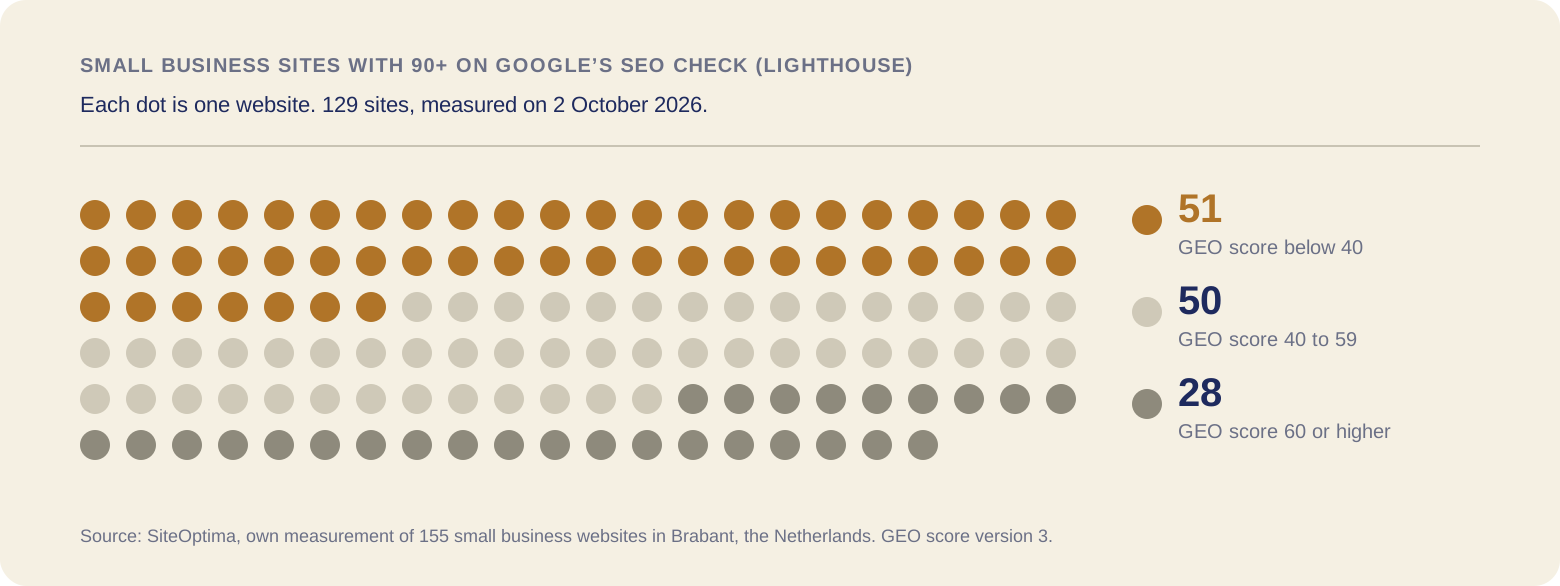
Worked out as a correlation, the two scores move together at 0.28. That is weak. A high SEO score makes a high GEO score slightly more likely, but you cannot read one off the other.
That makes sense once you look at what they measure. Lighthouse checks things like your title, your meta description, whether Google may index the page and whether links can be followed. Whether your page states, in a machine readable way, who you are, what you do and where you are, does not count in that score.
Where the points are lost
The GEO score has three parts. For the 129 sites with a good SEO score, the median score per part looks like this:
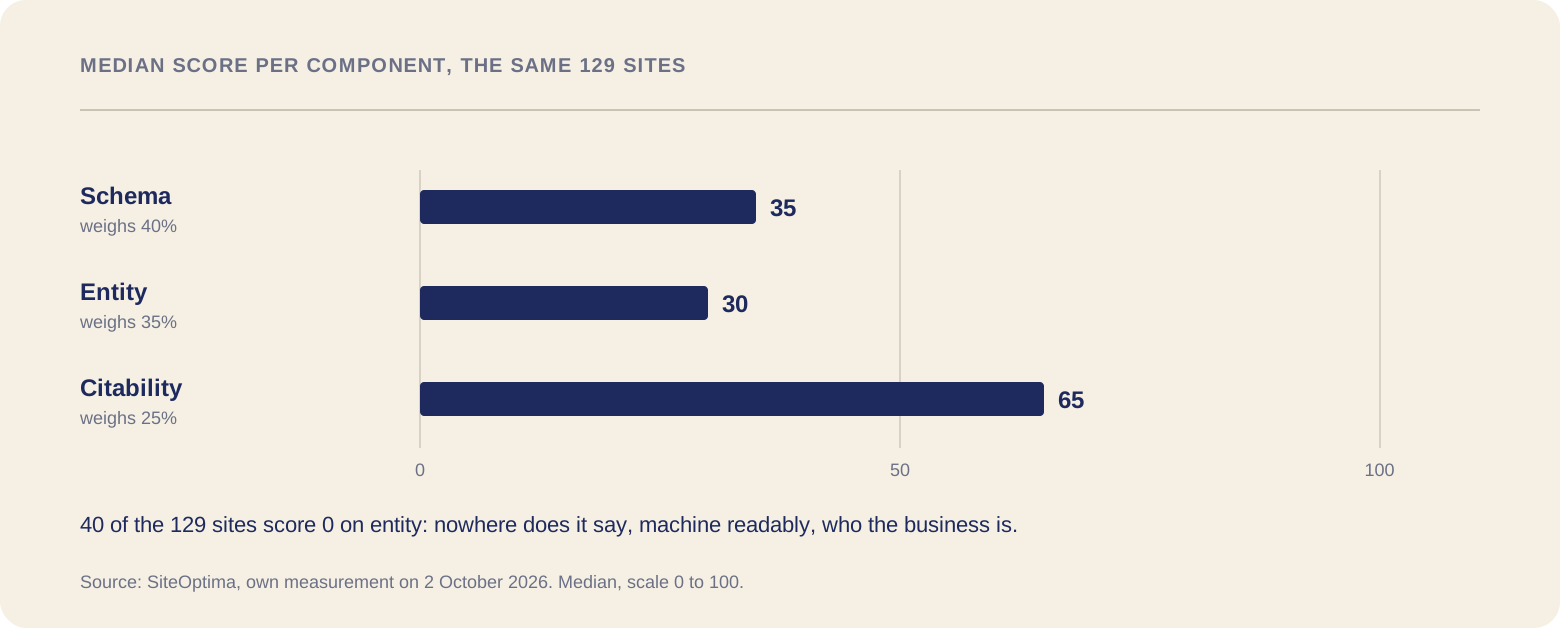
Citability holds up reasonably well. The text often has headings, numbers and answers to questions. Good SEO work had already taken care of that.
Schema and entity lag behind. Those are the bits of code that tell a machine this is a business, with this name, at this address, with this phone number and these opening hours. A visitor simply reads that off your page. An AI assistant has to guess when it is not stated in a structured way anywhere.
40 of the 129 sites score 0 on entity. On those sites, nothing states in machine readable form who the business is. For Google that is no problem, because Google has your Business Profile. An assistant reading your site to answer a question does not.
Why it matters now
A year ago you could still file this under later. This year’s figures make that harder.
Ruigrok surveys every year how Dutch people behave online. In May and June 2026, 2,311 Dutch people filled in the questionnaire. The share using AI at least weekly went from 19% to 40% in one year. The share that has ever used AI, from 43% to 65%.
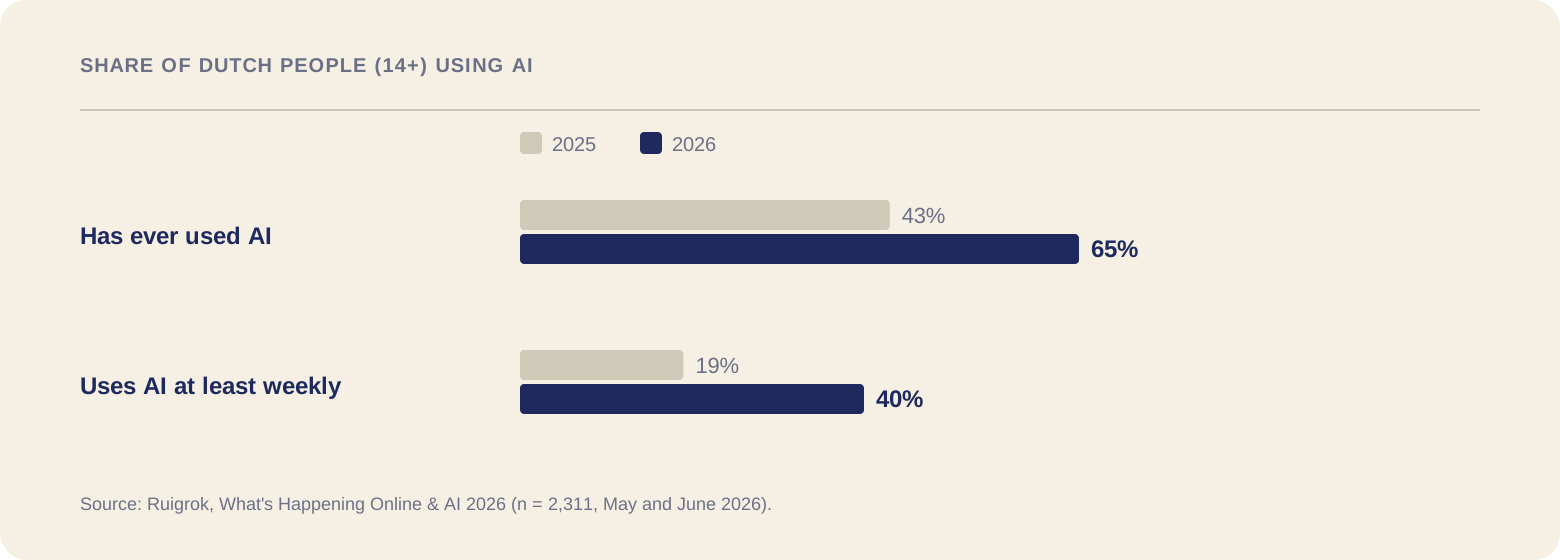
What those people do after AI recommends something, nobody in the Netherlands measures yet. Adobe’s figures above are the best picture there is.
That is the moment that matters. Someone asks ChatGPT for a roofer, gets a few names and goes to look. Your site is then read twice. Often first by the assistant that put the answer together, then by the person themselves.
Adobe also saw which pages an AI reads best: blogs, guides, frequently asked questions and support pages. Booking and checkout flows score lowest in every industry.
What we do not know
Two things you should know before drawing conclusions from this.
The GEO score is our own formula. It measures what we consider important for an assistant: schema, entity and citability. That good SEO and a low GEO score go together mostly shows that the two formulas measure different things. That is exactly the point of this article, but it is no proof that AI skips you because of it.
We cannot yet show that a higher GEO score gets you named more often. For 19 businesses we know both: the GEO score and how often AI names them in repeated checks. On the current scoring version, the top half is named in 33.6% of checks and the bottom half in 33.5%. The correlation is 0.17. That is too little to promise anything, so we do not.
Also: the Lighthouse scores come from the analysis we made of each site earlier, the oldest from April 2026. 17 sites could not be reached or read from our measuring environment and do not count. We left out 11 businesses because they are not small businesses, appeared twice in the list or are based abroad.
What remains is narrow but solid: a good SEO report says nothing about whether AI can read your site. For 4 in 10 sites that Google considers fine, an assistant can do little with them.
Have it measured separately
Your SEO report does not answer this question, because it does not look at it. If you want to know where your own site stands, have it measured separately. A SiteOptima analysis shows the three parts of your GEO score and, for each part, what is missing. Usually that is not a new website, but a few facts you already have, in a place where a machine can read them.
Book an analysis or a short call.
Sources: SiteOptima, own measurement of 155 small business websites on 2 October 2026 (GEO score version 3, Lighthouse SEO from the earlier analysis of each site). Ruigrok onderzoek en advies, What’s Happening Online & AI 2026, n = 2,311, May and June 2026. Adobe Digital Insights, AI Traffic Trends Report August 2026, US online retail, July 2026.
Frequently asked questions
What exactly does Lighthouse measure, and what not?
Lighthouse is the check Google itself builds into Chrome and PageSpeed Insights. Its SEO score looks at things like your page title, your meta description, whether the page may be indexed, whether links can be followed and whether images have alt text. Whether your page carries structured data that lets a machine read who you are does not count towards that score.
What is the GEO score?
Our own measurement of how well an AI assistant can read your site. It has three parts. Schema (40%) covers the machine readable facts in your source code. Entity (35%) covers whether those facts say who you are, where you are and how to reach you. Citability (25%) covers whether your text contains facts and answers an assistant can take over. It is our formula, not a standard. That is why this article also says what it does not prove.
Will ChatGPT name me more often if my GEO score goes up?
We cannot show that yet. For the 19 businesses where we have both, the GEO score and how often AI names them, the correlation on the current scoring version is 0.17. That is too weak to promise anything. What we do show: a good SEO score says nothing about whether your site is machine readable.
Do Adobe's figures apply to my business?
Not one to one. Adobe measures US online retail, with over 1 trillion visits and a survey of more than 5,000 Americans. An installer in Eindhoven is not an online store. We use those figures as a direction for what a visitor from AI does, not as a forecast of your revenue.
How do I find out my own GEO score?
Have your site measured separately. You then see the three parts, schema, entity and citability, with what is missing in each. That is something other than your SEO report, and it is not in there either.
Ready to be found by AI?
SiteOptima helps SMBs in and around Eindhoven become visible in Google and in ChatGPT, Gemini, and Claude. Start with a free audit.
Start free audit →